
こんにちはいちごのベッドです。
風の噂で、金融経済の知識を競う高校生向けのクイズ大会、「エコノミクス甲子園」が国際経済オリンピックとやらの日本代表選出大会になったということを聞きつけました。
!!なんかわからんけど凄そう!!
僕がエコ甲に出場したのは5年前?6年前?とかですが、そんなことになっているとは、、、
今日は国際経済オリンピックについて書いていきます
国際経済オリンピック(IEO)の歴史
国際経済オリンピック(以下、IEOと表記)の公式サイトがありました。勿論国際大会なので英語。
International Economics Olympiad (IEO) is an annual competition for high school students around the world in the areas of Economics and Finance. The Olympiad is supported by Eric Maskin, winner of the Nobel Prize for Economics in 2007. Participation is free of charge.
ふむふむ。
・2007年のノーベル経済学賞受賞者でアメリカの経済学者のエリック・マスキン氏がサポートしている
・経済と金融分野に特化した、世界中の高校生のための大会である
・参加無料
みたいなことが書いてますね。
ノーベル経済学賞受賞者がバックにいるなら、怪しい大会ではなさそうです。
2018年に第1回大会を行い、今年(2024年)で7年目みたいですね。
第1回大会の優勝チームはラトビアですが、その後はブラジルがかなり強いみたいです。
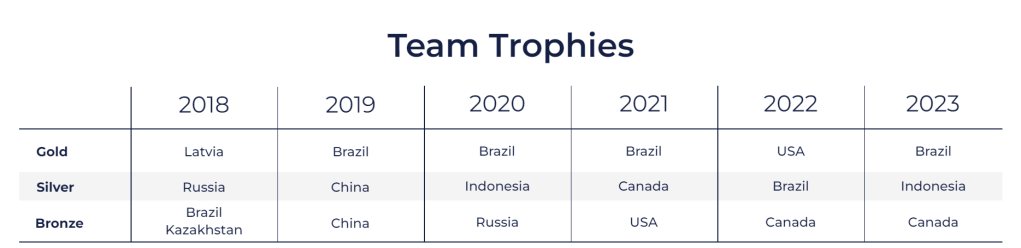
7年目ということでまだそんなに歴史がある大会ではないようですが、直近の2023年の大会では47か国が出場するなど、絶賛拡大フェーズにある大会のようですね。
IEOの内容
IEOは大きく分けて3つのラウンドに分かれているようです。
①Financial Literacy (金融リテラシー) ②Economics (経済学) ③Business case (ビジネスケース)
何やら難しそうな感じ。。。
1つずつ見ていきましょう。
①Financial Literacy (金融リテラシー)
3.1. The tasks in Financial Literacy should test contestants’ understanding of basic financial concepts and models, their ability to apply them and analytical skills.
3.2. The topics discussed in the questions of the Financial Literacy part are the following:
– Budgeting
– Banks and the banking system
– Saving money: deposits
– Borrowing money: credit
– Personal financial management
– Investment, instruments and risk management
– Insurance contracts and insurance market
– Financial fraud and Ponzi schemes.3.3. The recommended resources for the Financial Literacy part are:
- The Economy by the CORE Econ project (any language, Unit 10 “Banks, money, and the credit market”). The textbook is available at https://www.core-econ.org (free of charge).
- Personal Finance course by GFLEC (https://gflec.org/education/personal-finance-course/)
- Money Smart for Young Adults curriculum (https://www.fdic.gov/resources/consumers/money-smart/teach-money-smart/money-smart-for-young-adults.html)
- Financial Literacy Curriculum by PWC (https://www.pwc.com/us/en/about-us/corporate-responsibility/access-your-potential/financial-literacy-curriculum.html)
3.4. The Financial Literacy part of the IEO includes 25 multiple choice questions (MCQ). Questions test the understanding of financial concepts and contestants’ ability to apply them in realistic scenarios.
3.5. The overall time limit of the Financial Literacy part is 60 minutes.
3.6. Answers to all 25 MCQs are graded. A correct answer adds 4 raw points, an incorrect answer subtracts 1 point, unanswered questions don’t change the score.
出典:https://ecolymp.org/prepare#syllabus
金融リテラシーパートでは、参加者は制限時間60分以内に、25問の金融リテラシーなどに関する選択問題を解き、その点数を競います。
正解すると+4点、不正解で-1点、無回答は0点です。
出題分野は
– 予算編成
– 銀行と銀行システム
– お金を貯める: 預金
– お金を借りる: 信用
– 個人の財務管理
– 投資、商品、リスク管理
– 保険契約と保険市場
– 金融詐欺とポンジ スキーム。
のようです。
筆記の形式、問われる内容共に、エコ甲に近い気がしますね。
ただ、国際大会ということもあるので、ローカルなエリアでの金融のしくみ等に関してではなく、グローバル市場の金融に関することや、大学の経済学部で学ぶような金融工学の知識などについて問われるのでしょうね。
2024年に出題された問題
②Economics (経済学)
2.1. The tasks in Economics (the first part of the competition) should test contestants’ understanding of basic economic concepts and models, their curiosity about the field and analytical skills.
2.2. The topics discussed in the questions of the Economics part are the following:
- Economics principles and an economist’s worldview
- Microeconomics:
- Competitive markets (demand and supply, elasticities, equilibrium)
- Consumer’s choice
- Firm’s behavior
- Non-competitive markets (monopoly, oligopoly, monopolistic competition)
- Government interventions in competitive and non-competitive markets
- Market failures (externalities, public goods, asymmetric information)
- Labor market
- Game theory: Nash Equilibrium, cooperation, and coordination
- Innovations
- Macroeconomics:
- Macroeconomic data: measuring income, inflation and unemployment
- Technology and long-run growth;
- AD-AS model
- Money and monetary policy
- Fluctuations, crises, and fiscal policy;
- Inequality
- Institutions
- International Economics:
- Specialization and gains from trade
- Protectionism: winners and losers
- Currencies, currency unions, and exchange rates
- Economics of the environment and sustainable development
- Relevant research in economics
- Topics in economic science that attract the most popular attention; in particular, from fields for which Nobel Memorial Prizes in Economic Sciences have been awarded (understanding general concepts).
2.3. The main recommended textbook for the Economics part is The Economy by the CORE Econ project (any version and language). The textbook is available at https://www.core-econ.org (free of charge).
Supplementary recommended textbook for preparation is Principles of Economics by N. Gregory Mankiw (the newest edition).
If these resources are unavailable for contestants, they can use other economics textbooks of principles level.
For Nobel Memorial Prizes, see the website: https://www.nobelprize.org/prizes/lists/all-prizes-in-economic-sciences/.2.4. The Economics part of the IEO includes 20 multiple choice questions (MCQ) and 5 open questions (OQ). Multiple choice questions test the basic understanding of economic concepts (which may include simple calculations). Each of the 5 open questions will be stated either quantitatively (include calculations) or qualitatively (include detailed explanations) or both.
2.5. The overall time limit of the Economics part is 235 minutes. Upon the decision of the Steering Committee confirmed by the Problem Committee, the overall time can be divided in two segments: one for MCQ and one for OQ, with or without a break between those parts. If this happens, the decision on lengths of the break and segments is to be taken by the Problem Committee.
2.6. Answers to all 20 MCQs are graded. A correct answer adds 4 raw points, an incorrect answer subtracts 1 point, unanswered questions don’t change the score.
The maximum grade for each open question is 30 raw points. Out of 5 open questions, only 4 are graded by the Jury. If a contestant provides non-empty solutions to all 5 questions, they must specify the question that shouldn’t be graded. If in this case a contestant has failed to specify a solution not to be graded, the maximum grade of 5 OQ scores will be excluded.2.7. Open questions are graded with full or partial credit depending on the contestant’s progress. The following principles are used.
2.7.1. The Jury reviews papers according to grading schemes. In the case of a contestant’s work containing a solution fragment that cannot be assessed based on the grading scheme, the Jury makes a decision based on its understanding of fair assessment, possibly consulting with the Problem Committee. The Jury assesses only what is written in the contestant’s paper.
2.7.2. Fragments crossed out by the contestant in their paper are not reviewed by the Jury. If a contestant wants to undo the crossing out, they must explicitly write in the paper that they wish the crossed-out part to be evaluated. If it is impossible to determine conclusively whether the contestant wanted the solution fragment to be assessed, that fragment is not evaluated.
2.7.3. Contestants must present their solutions in clear English language. The Jury does not deduct points for language mistakes, corrections, spelling, punctuation, and stylistic errors or deficiencies in paper formatting, as long as the contestant’s solution is understandable.
2.7.4. All statements in the contestant’s solution must either be commonly known (standard) or logically follow from the question or the contestant’s previous reasoning. A contestant does not need to prove commonly known statements. Generally, facts repeatedly used in previous International Economics Olympiads without proof in official solutions are considered commonly known, as well as standard high school curriculum material. All non-commonly known facts not trivially derived from the question must be proven. A solution explicitly or implicitly relying on unproven non-commonly known facts is rated with a partial score.
2.7.5. Contestants can solve questions using any correct method. The Jury does not increase scores for elegance or conciseness of the solution, nor does it decrease scores for using an unconventional method. A correct solution may deviate from the official one in its method. The length of the solution does not directly impact the evaluation; if a contestant writes a lengthy text without advancing the solution, it should be scored zero.
2.7.6. The contestant’s work should leave no doubt about the method of solving the question. If a contestant presents multiple solutions to a question that are substantially different (potentially leading to different answers), and some of the solutions are incorrect, the Jury is not obligated to choose and evaluate the correct solution.
2.7.7. If the contestant’s solution contains contradictory statements, they are generally not evaluated, even if one of them is correct. Violation of logical sequences (cause-and-effect relationships) typically results in a significant reduction in the score.
2.7.8. The contestant’s work must include evidence of the completeness and correctness of their answer. The method of obtaining the answer, if not required for proving its completeness and correctness, is optional to present.
2.7.9. Penalties assigned by the Jury for computational errors depend on the severity of the consequences. Computational errors that did not significantly alter the subsequent solution of the question and made it substantially simpler are penalized with fewer points than errors that had a substantial impact regardless of the impact on the final conclusion. The grading key should specify the exact penalties for arithmetic mistakes whenever possible.
2.7.10. If a question has multiple parts, the contestant must clearly indicate where the solution to each part begins. If a contestant’s solution to one part of the question includes a solution fragment that, according to the marking scheme, can earn points for another part of the question, the Jury may choose not to award those points if it is not evident that the contestant understands the applicability of the results to another point. When solving question parts, contestants can refer to their own solutions (answers) to other parts.
2.7.11. If an error occurs in the initial parts of a solution and it changes the contestant’s answers in subsequent parts, the scores for subsequent parts are generally not reduced. They are evaluated as if the contestant’s own results, used by the contestant, were correct. Exceptions occur when errors in the initial parts simplified or qualitatively distorted the logic of the subsequent solution — in these cases, scores for subsequent parts may be significantly reduced.
2.7.12. If additional assumptions are necessary for the contestant’s solution, they must be formulated. These additional assumptions should not change the meaning of the question and significantly narrow the range of situations discussed in the solution compared to those specified in the condition.
出典:https://ecolymp.org/prepare#syllabus
経済学パートでは、参加者は制限時間235分以内に、選択問題20問と記述問題5問を解きます。
選択問題20 問は、正解すると+4点、不正解で-1点、無回答は0点です。
記述問題5問は、1問あたり30ポイントを満点として採点されます。ただし、5 つの記述問題(オープンクエスチョン)のうち、審査員が採点するのは 4 つだけで、出場者はどの1問を採点されない問題にするか指定する必要があります。出場者が採点しない解答を指定しなかった場合、最も点数の高かった問題のポイントが除外されます。
出題分野は
経済の原則と経済学者の世界観
ミクロ経済学:
競争市場 (需要と供給、弾力性、均衡)
消費者の選択
企業の行動
非競争市場 (独占、寡占、独占的競争)
競争市場と非競争市場における政府の介入
市場の失敗 (外部性、公共財、非対称情報)
労働市場
ゲーム理論: ナッシュ均衡、協力、調整
イノベーション
マクロ経済学:
マクロ経済データ: 所得、インフレ、失業の測定
テクノロジーと長期成長
AD-AS モデル
お金と金融政策
変動、危機、財政政策
不平等
制度
国際経済学:
専門化と貿易による利益
保護主義: 勝者と敗者
通貨、通貨同盟、為替レート
環境経済学と持続可能な開発
経済学の関連研究
最も注目を集める経済科学のトピック。特に、ノーベル経済学賞が授与された分野から (一般的な概念の理解)
です。
これって、大学の経済学で学ぶ内容では!?!?
ノーベル経済学賞が授与されたテーマからの出題もあるなど、出題分野がかなり多岐にわたっているため、幅広く勉強することが求められそうです。
また、試験時間も約4時間と、かなり消耗しそうですね。
ですが、特にオープンクエスチョンは配点が高いため、ここでしっかりと解答して点数を取ることが上位入賞のためには重要となってきそうですね。
2024年度の問題
IEO2024 Economics Multiple Choice Questions
IEO2024 Economics Open questions
③Business case (ビジネスケース)
4.1. The competition in business is a team competition and includes the oral presentation of the results. Presentations must be supported by slides. The presentations should be in English.
4.2. Case study part is a team competition and lasts for two days — 1) day of preparation; 2) day of the presentation. During the day of preparation, contestants may use any online and offline materials, but it is prohibited to contact other people for help. All teams submit their slides by the deadline specified by the Steering Committee prior to the IEO Opening Ceremony. No changes to slides are allowed after this time.
4.3. On the day of presentation, teams are divided into groups. Each group is assigned a separate panel of judges.
4.4. The top team from each group is invited to the public Business Case Finals. In the Finals, teams are to present their solution again and be graded by a panel of judges.
4.5. Raw scores for the Business Case part are counted as a sum of scores for each criterion. The score for each criterion is the median of scores for this criterion given by each judge of the panel. The final result of a team participating in the Business Case Finals is the maximum of two results: in a group stage and in Finals.
4.6. Business case solution consists of several parts. Here are the competencies contestant should acquire, that will be evaluated by the Jury, related to those parts:
Analytical thinking: the ability to structurally approach the solution of a complex business problem, correctly dividing it into streams (into directions within which the solution
of the problem may lie).As a rule, the team should divide the case into some large blocks, which, in turn, are further divided and so on to the level of specific problems. A good structure corresponds to the MECE principle (mutually exclusive, collectively exhaustive), that is, it covers all possible solutions, but each individual stream does not intersect with others.
Conceptual thinking: the ability to build correct hypotheses based on the resulting structure, made by analysis. Here the team checks how ideas respond to the necessary request and correctly address these or other problems of the enterprise, the team also makes sure that these solutions are feasible and have a common and business sense.
Quantitative thinking: no case can be solved without simple but fast calculations and more complex models that illustrate certain analyzes.
Communication skills: the ability to correctly build a presentation and to answer questions.
4.7. The PC recommends the following literature. Useful literature for case solving:
- The Pyramid Principle, Barbara Minto;
- Crack the Case, David Ohrvall;
- The Trusted Advisor, D. Maister, C. Green, R. Galford.
Useful literature for data analysis:
- The McKinsey Way, Ethan Rasiel;
- Strategic Management, Thompson Strickland;
- The Fifth Discipline, Peter Senge;
- Thinking Fast and Slow, Daniel Kahneman;
- Case in Point, Marc Cosentino;
- BCG on Strategy, C. Stern, M. Deimler.
Useful literature for presentations:
- Say It With Charts, Gene Zelazny;
- Unfolding the Napkin, Dan Roam;
- Visualize This, Nathan Yau;
- The Pyramid Principle, Barbara Minto;
- Slide:ology, Nancy Duarte
4.8. In addition to books listed above, the PC recommends studying the example cases that were used at the previous Olympiads and can be found here: https://ecolymp.org/prepare. Additional materials for preparation will be provided to the invited teams before the Business Case part.
出典:https://ecolymp.org/prepare#syllabus
ビジネスケースは、チームでテーマにあったプレゼンテーションを作成し、英語で発表・質疑応答まで行うものです。
ビジネスケースは2日間かけて行われ、1日目に準備をし、2日目にプレゼンを行います。
プレゼンは以下の4つの評価基準をもとに採点されます
Analytical thinking
Conceptual thinking
Quantitative thinking
Communication skills
2024年の香港大会のテーマは、
香港における住宅の不足や高騰などの問題に関するものでした。
香港代表の選手が大分有利になるような気はしますが、開催国ですしそんなもんなんですかね。。。
こちらが2024年香港大会で出題された実際の問題です。7枚のスライドで詳細にバックグラウンドやタスクが説明されており、まるでプロのコンサルが行うケーススタディのようになっています。
24時間で、現在の香港の住宅問題の状況調査から、政策の評価、新たな政策の提案などを行い、プレゼンテーションを完成させるのはかなり難しい気がします。
ここで良い点を取るには、英語力やプレゼンテーション力だけでなく、課題解決のための論理的思考力やチーム内で協力する力など、幅広い力が必要となってきそうです。
↓↓↓ こちらはIEO 2024でのビジネスケース決勝の様子です。高校生離れしたプレゼンテーションを見ることができます。
感想
Financial Literacy と Economicsの内容は、大学レベルの経済金融の問題が普通に出題されるだけでなく、出題分野も多岐にわたり、計算問題では数IA2Bの知識が必須になるようなものもあり、非常にハイレベルであるように感じました。もちろん、ベーシックな経済学のモデルに関する内容も含まれており、すべての問題が難問ではなさそうですが、高校生で解くのはかなり難しいと思います。さすが国際大会です。またすべての問題が英語ということもあり、経済の知識だけでなく英語の単語力やリーディング力も必要とされそうですね。
個人的に最も難しそうだと感じたのはBusiness Caseです。
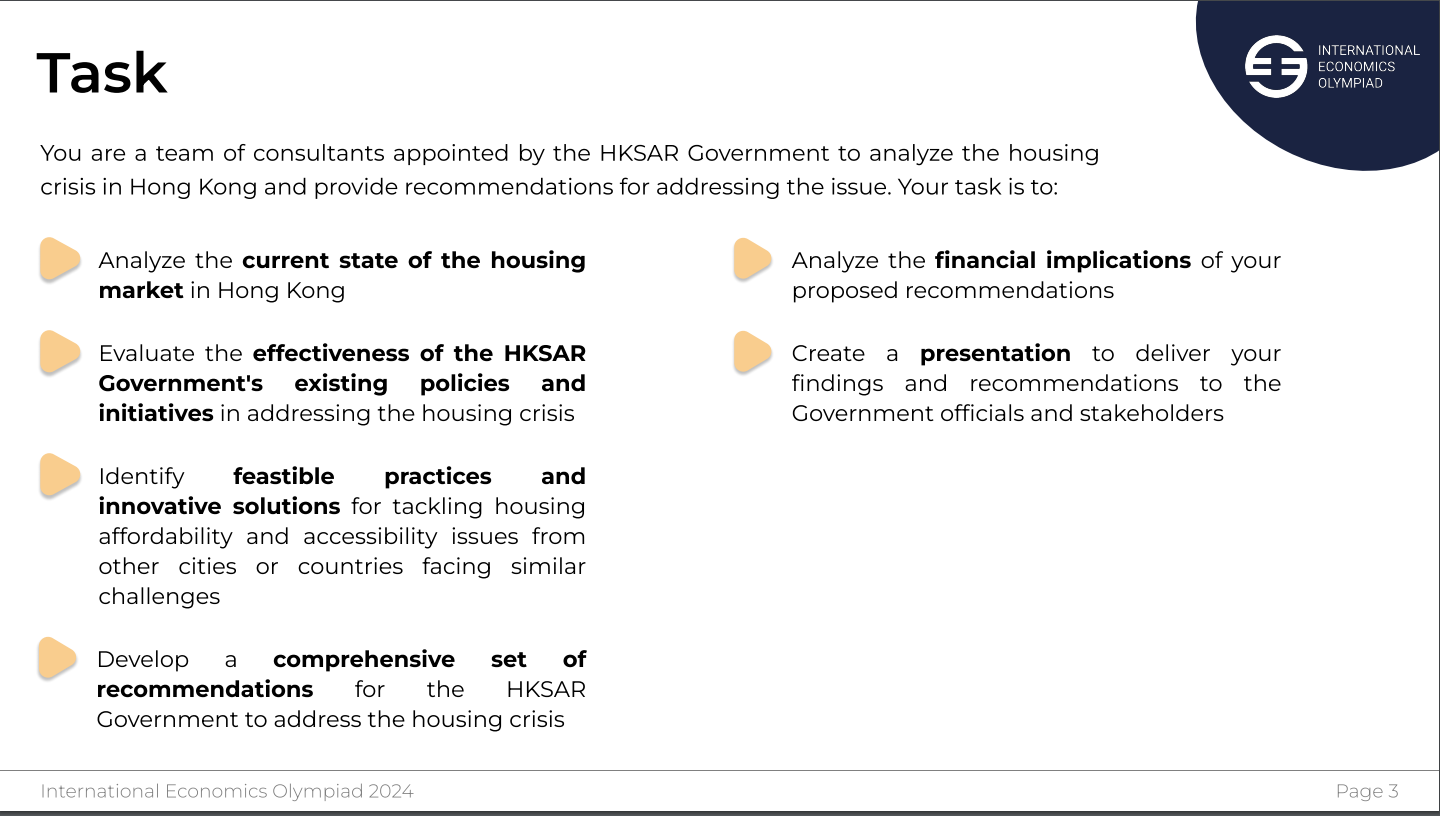
上の画像は2024年に出題された実際の問題ですが、24時間の間で、現在の香港の住宅問題の状況を調べるだけでなく、政策の効率性の評価、解決策の提示、経済的な影響の分析などのタスクを行い、1つの英語プレゼンテーションにそれをまとめる必要があります。もちろん1人でやるわけではないので、代表チーム全員で協力すればプレゼンテーションを完成させることはできると思いますが、効率的に役割分担をし、全員をまとめるリーダー的な人がいないときれいなプレゼンはできない気がします。勉強だけでなく、実際の仕事で求められるようなソフトスキルも必要とされてくるでしょうね。
日本代表が初めてIEOに派遣されたのは2023年。今後5年以内くらいには、日本代表としてぜひメダルを獲ってきてくれたらアツイなあ、なんて思ってます🤩




 いちごのベッドのサイドテーブル
コメントを残す